

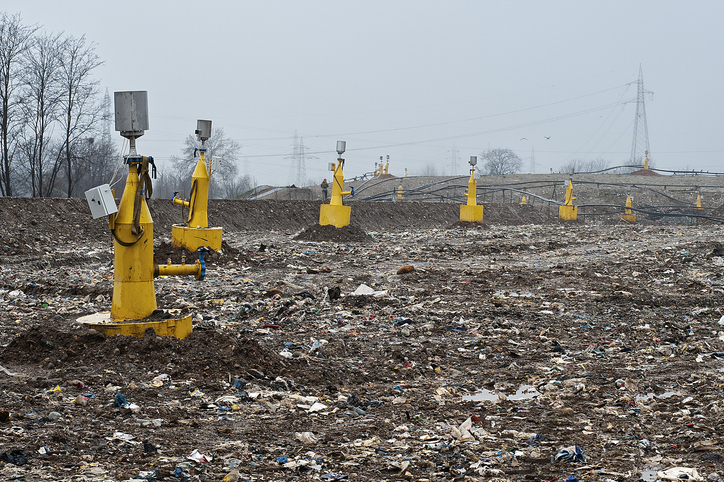
To the untrained eye, a landfill looks like a static pile of earth. But underneath the surface, it is a dynamic, breathing environment. To prevent dangerous pressure buildup, odors, and migration, operators rely on landfill gas collection. Are you wondering, “How does a landfill gas collection system work?” From the bottom of the waste pile to the flare stack, here is the step-by-step physics of the process.
The Core Concept: Negative Pressure
At its simplest level, an active LFG system works like a giant vacuum cleaner.
Decomposition creates positive pressure inside the landfill (pushing gas out). The collection system applies negative pressure (suction) to specific points within the waste mass. This pressure differential forces the gas to flow into the piping network rather than escaping through the surface cap or migrating into the surrounding soil.
Step 1: Extraction (The “Straw” Effect)
The process begins deep inside the waste mass. Vertical extraction wells are drilled into the landfill, often reaching depths of 50 to 100 feet. Think of these wells as straws inserted into a drink. The “suction” is applied at the surface via the wellhead.
How it works mechanically:
-
Perforation:
The bottom portion of the well pipe is perforated (full of holes).
-
Radius of Influence:
When the vacuum is turned on, it pulls gas from the surrounding waste. This is called the “radius of influence.”
-
Tuning:
Technicians adjust the valves on the wellhead to balance the flow. If they pull too hard, they might suck in oxygen (which kills the methanogenic bacteria). If they pull too softly, gas escapes.
Step 2: Transportation (Managing the Flow)
Once the gas enters the well, it travels up to the surface and into the lateral piping (the black pipes seen in the image above). These smaller pipes feed into a larger “header” pipe that circles the landfill perimeter.
The Condensate Challenge
This is where the system often faces mechanical hurdles. Landfill gas is hot (often 100°F+) and fully saturated with moisture. As it travels through the cooler surface pipes, that moisture condenses into liquid water, known as condensate.
For the system to work, this liquid must be separated from the gas. The piping is pitched at a precise angle to allow gravity to drain the water into “condensate knockouts” or sumps. If these sumps aren’t pumped out regularly, the water acts like a P-trap in a sink, blocking the flow of gas completely.
Step 3: The Vacuum Source (The Blower)
What generates the suction? All the piping leads to a central facility housing a blower skid.
The blower acts as the lungs of the entire operation. It creates the negative pressure required to pull the gas through miles of piping. Industrial sensors monitor the vacuum levels 24/7; if the pressure drops, the system automatically flags that a blockage (usually liquid) has occurred somewhere in the field.
Step 4: Destruction or Conversion
The final stage is managing the extracted gas. Once it passes through the blower, it is pushed into a destruction device:
-
The Flare:
In most systems, the gas is sent to a flare stack where it is incinerated at high temperatures. This converts the methane (a potent greenhouse gas) into carbon dioxide.
-
Energy Recovery:
In advanced systems, the gas is dehydrated and filtered, then fed into massive engines to generate electricity for the local grid.
Keeping the System Running
While the concept is simple (“suck gas out, burn it off”), the reality is messy. Landfills settle, pipes break, and wells “water out.”
A system that works perfectly on paper will fail without hands-on intervention. That is where CABENO comes in. We specialize in the physical operation and maintenance (O&M) required to keep these systems running.
- See how we maintain these systems: Landfill Gas System Operation & Maintenance
- Request a system audit: Contact Us Today.