

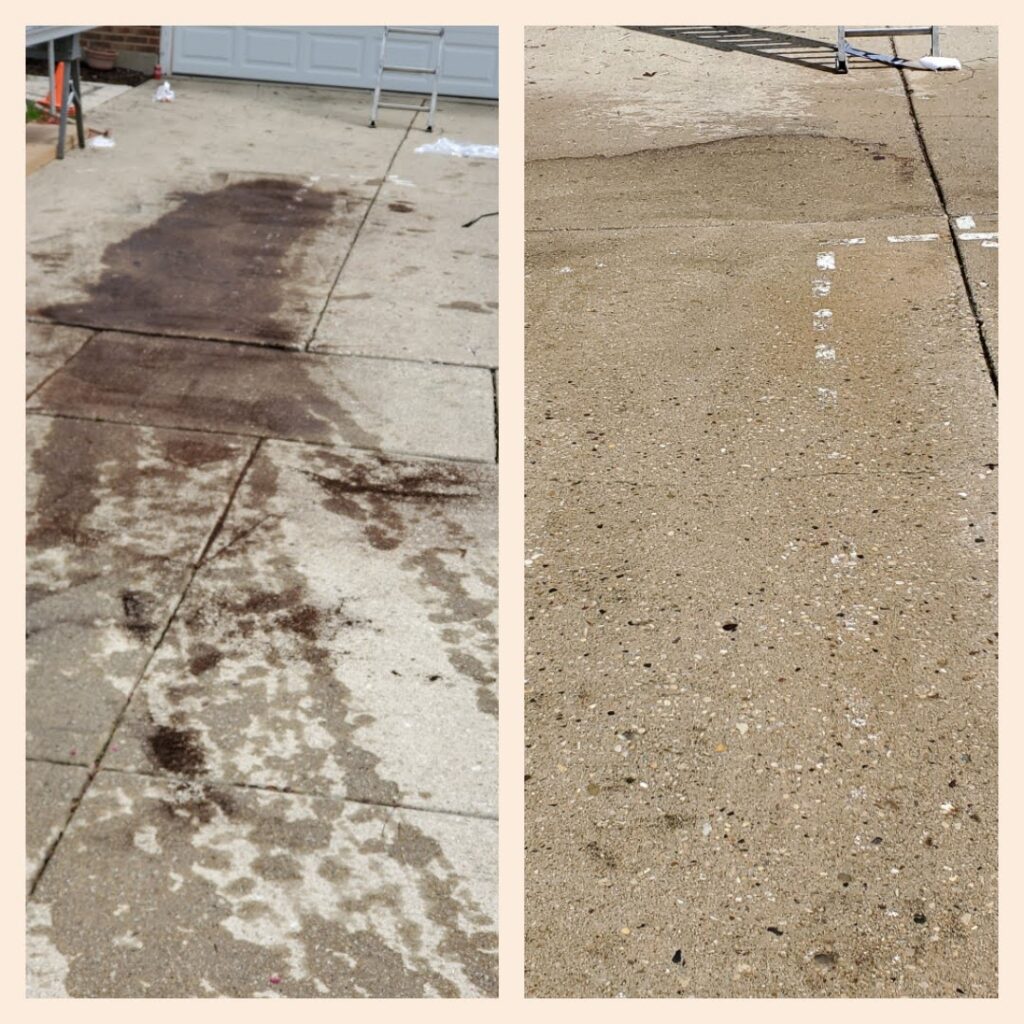
It’s a common Saturday afternoon scenario: You notice an ugly, dark oil spot on your driveway or garage floor. You drag out the pressure washer, hook up the hose, and spend twenty minutes blasting the spot with 3,000 PSI of water.
When the concrete is wet, it looks like the stain is gone. But an hour later, when the surface dries, that stubborn dark shadow reappears.
If you have been relying solely on a pressure washer for oil stains, you know the frustration. But why does it happen? Why can a machine powerful enough to strip paint fail to remove a simple oil drip?
The answer lies in the basic science of concrete, asphalt, and the chemistry of oil versus water. Here is why brute force isn’t enough, and the smarter way to tackle hardscape stains.
Does Pressure Washing Remove Oil Stains? The Short Answer.
If you search online for “does pressure washing remove oil stains,” you will find mixed results. The honest answer is: No, not entirely.
A pressure washer is fantastic at removing surface-level dirt, moss, and grime. If you have a fresh, thick glob of grease sitting on top of the concrete, a pressure washer will blast that top layer away.
However, it rarely solves the real problem: the stain itself.
The “Concrete Sponge” Effect
Concrete looks solid, but under a microscope, it is a rigid sponge full of tiny pores and capillaries.
When oil hits concrete, it doesn’t just sit on top; it soaks deep into those pores. Motor oil is “hydrophobic,” meaning it repels water. When you hit an oil stain with high-pressure water, two things happen:
- The water molecules bounce off the oil molecules.
- The immense pressure can actually drive the oil deeper into the concrete’s pores to escape the force of the water.
While pressure washing oil stains might make the spot look 20% better by cleaning the surface dirt around it, you often end up embedding the core of the stain further into the substrate.
The Danger Zone: Pressure Washing Asphalt
The risks are even higher if you are dealing with a blacktop driveway. A common question homeowners ask is: “Can you pressure wash oil stains off asphalt?“
You need to be extremely careful. Unlike concrete, asphalt is soft. It is essentially small rocks (aggregate) glued together by tar (binder).
If you use a high-powered pressure washer tip directly on an asphalt oil stain, the water pressure can be stronger than the tar binder. You won’t just remove the oil; you will blast away the aggregate, leaving pitted, damaged areas in your driveway that will eventually turn into potholes.
For asphalt, chemical cleaning is always safer than mechanical force.
The Solution: Chemistry Over Brute Force
To successfully remove an oil stain, you need to stop thinking about pushing it with water and start thinking about lifting it with chemistry.
You need to break the bond between the oil and the pavement. This requires a two-step process depending on the severity of the stain.
Step 1: Attack the Surface Goo (The Emulsifier)
If you have fresh, wet oil or thick grease on the surface, you need an emulsifier. An emulsifier is a specialized cleaner that surrounds oil molecules and allows them to mix with water.
Instead of blasting the spot immediately, treat it with CABENO Surface Prep & Oil Remover.
This eco-friendly formula breaks down the surface grease that water alone can’t touch. Once the cleaner has done its work, you can use your garden hose or pressure washer on a low setting to easily rinse away the emulsified sludge.
Step 2: Remove the “Shadow” (The Deep Cleaner)
Often, after cleaning the surface, a dark gray “shadow” remains. This is the oil trapped deep in the pores of the concrete. A pressure washer cannot suck this out.
To remove the shadow, you need a product that works via capillary action, essentially acting like a powerful paper towel that pulls the oil up out of the concrete.
For this stubborn, embedded oil, you need CABENO’s Oil Stain Remover. You apply it, let it dry into a powder, and sweep it away. As it dries, it physically wicks the oil from deep within the pores.
Work Smarter, Not Harder
A pressure washer for oil stains is a useful tool, but it’s not a magic wand. Without the right chemical assistance, you are just pushing water at a hydrophobic substance. By understanding the science of your pavement, you can stop wasting your Saturday afternoons blasting stains that won’t budge. Use the right chemistry first, and save the pressure washer for rinsing.
Visit our products page to purchase our oil stain prep/removal products for yourself.